SGM Senior Environmental Consultant Alex Nees shares insights on invasive zebra mussels and their potential impact on projects within the Colorado River drainage. Alex is a biologist with more than a decade of experience in western Colorado. He specializes in environmental permitting and compliance, including NEPA, CDOT environmental review, the Endangered Species Act, and the Clean Water Act.
Read the Q&A below to learn what this could mean for your project.
What Are Zebra Mussels—and Why Do They Matter in Western Colorado?
Zebra mussels (Dreissena polymorpha) are an invasive freshwater mollusk from eastern Europe that has been a major issue in the Great Lakes region for decades. As with other mussels, clams, and related animals, the adults are largely stationary filter feeders that siphon water through their bodies and extract small food particles. Zebra mussels are often addressed with, or conflated with, their close relative the quagga mussel (D. bugensis). The quagga mussel has been established in Lakes Mead and Powell for over a decade, but are not currently known in Colorado. However, zebra mussels have recently been confirmed as reproducing in Colorado.
Zebra mussels present a significant threat because they reproduce so rapidly, and their colonies of anchored adults are so dense that they clog water pipelines and ditches, damage boats, and can even colonize power turbines and cooling systems. They also grow in such densities that they can consume most of the free-floating microscopic food in the water body, starving out native filter feeders and the predators that rely on them. Although native species, including both fish and waterbirds, can eat zebra mussels, there are no native species that can eat them fast enough to control the population growth and spread.
What Do Zebra Mussels Mean for Project Design and Construction?
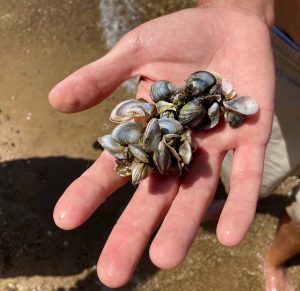
Zebra mussels can easily spread from project site to project site, usually hitching a ride on construction equipment. Adults are small—no larger than a fingernail—and can survive out of water for days. Their microscopic larvae can travel in small amounts of trapped water. Construction equipment can inadvertently transport adults in tires or on frames, while larvae can survive in pumps, pipes, or tools. Because of this, the risk of spreading the species during in-stream work is significant.
There are two primary design and construction considerations that our in-house consultants and engineers consider:
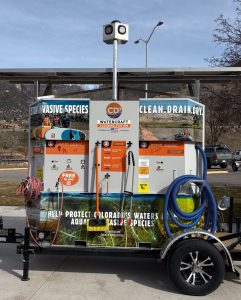
Decontamination protocols: Colorado Parks & Wildlife (CPW) has developed standardized decontamination protocols that apply to all projects in infested waters. SGM staff work to incorporate these protocols into project specifications for applicable in-stream work. We recommend that decontamination stationing and protocols be incorporated as a separate pay item for projects in zebra mussel habitat. This provides both encouragement and accountability for construction contractors to comply with the requirements.
Infrastructure design considerations: When SGM is designing inlets, pumps, culverts, and similar infrastructure, it is important to account for the risk of zebra mussel colonization and clogging. Specialized surface coatings can help reduce colonization. Fine screening systems can also block larvae before they enter equipment, though these screens are extremely small (about half the width of a human hair) and may affect water flow rates or operating pressures. For critical or high-value facilities, incorporating these measures during design can help reduce long-term maintenance costs.
If your project is located in perennial waters within the Colorado River drainage below the Eagle River, it’s safest to assume zebra mussels are already present.
How is SGM taking steps to stay ahead of zebra mussel requirements in projects?
At SGM, our environmental and engineering teams work side by side to help design projects move forward smoothly while protecting Colorado’s water resources. Decontamination requirements are standardized and are built directly into project plans when needed. The environmental team can identify which projects may be at risk from zebra mussels, but in general we recommend that any work in perennial waters within the Colorado River drainage below the Eagle River move forward assuming zebra mussels are present.
Zebra mussels are regulated by Colorado Parks & Wildlife (CPW) under the State’s Aquatic Nuisance Species program. Projects where CPW has regulatory authority or a consultation role may require specific control measures. Our environmental team helps manage agency coordination and incorporates these requirements into our typical environmental documentation.
Projects most likely to be affected include those requiring SB40 certification — particularly CDOT projects within stream corridors — as well as certain oil and gas developments and local land use projects where CPW serves as a consulting agency.
What steps can clients or project owners take to stay ahead of zebra mussel compliance?
For entities that own or manage large on- or off-channel water bodies, now is the time to begin considering monitoring and prevention strategies. Many of the waters infested to date have been isolated ponds in riparian areas, often with limited or poorly controlled connections to nearby rivers. Private water ski ponds, ranch ponds, and fishing ponds are considered high-risk locations.
Facilities that operate with passive water flow at lower volumes or pressures may be able to retrofit mussel exclusion screens relatively easily. Exploring these options early can help reduce long-term maintenance costs while demonstrating responsible water resource management.