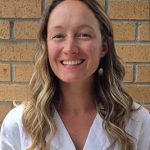
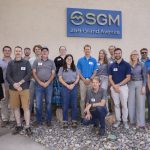
Haley Farwell is a Data Analyst on SGM’s Water Resources and Environmental team, bringing more than eight years of experience in ecohydrology to communities across Western Colorado.
Based in Durango, her work takes her from mountain watersheds and field sites to complex datasets, where she turns information into practical insights that can help communities and water managers make informed decisions. Read our Q&A to learn more about Haley, her expertise, and the perspective she brings to SGM’s Water Resources team.
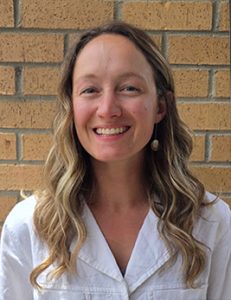
Haley Farwell,
Data Analyst
Water Resources/Environmental Sector
Tell us a little about yourself and what you do at SGM.
I have over eight years of experience in ecohydrology, with a background spanning surface water hydrology, snow hydrology, abandoned mine hydrology, water measurement and automation, and wetland and riparian vegetation monitoring. I received my master’s in forestry at Northern Arizona University (NAU), where I conducted research on snow and soil water dynamics in Ponderosa Pine forests in the San Juan Mountains of Colorado.
Now at SGM, my role on the Water Resources/Environmental team involves analysis of complex datasets, developing data visualizations and streamlining data processes, and informing decisions on water quality, rights, supply and demand forecasting, and ecological habitat analysis. Much of my time recently has been dedicated to the Colorado Water Conservation Board’s (CWCB) Diversion Measurement Installation Programming, designing flumes, coordinating with subcontractors, water users, and the Division of Water Resources. (CWCB’s Diversion Measurement Installation Program provides funding to help Colorado River Basin water users install structures and equipment that measure water diversions – learn more here.)
How did you get into water resources and environmental work?
I have always loved being outside, but I think there was one experience that solidified my decision to get into environmental work. I received my undergraduate degree in Ecosystem Science and Sustainability from Colorado State University, where I was required to fulfill a course of field credits. I decided to head north and attend the Tatoosh School in Southeast Alaska. There, I spent six weeks in the Tongass National Forest studying the local aquatic and terrestrial ecology from a sea kayak. After that experience, I knew I wanted to pursue a career where I could chase my curiosity about the natural world around me.
What does a typical day look like for you—or is there such a thing as a typical day?
I don’t think there is a typical day, but it’s usually busy!
Your work includes both time in the field and time analyzing data. What do you enjoy about that mix?
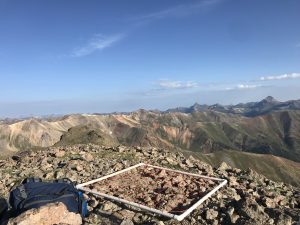
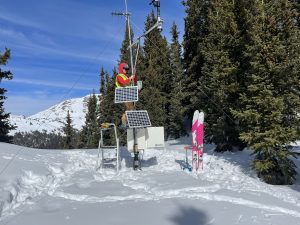
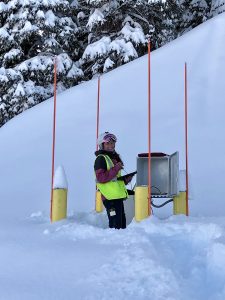
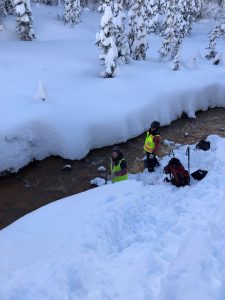
There have been times during my career where I have spent days and weeks in the field backpacking, backcountry skiing, or snowmobiling to field sites. Often, there was a lot of snow shoveling involved! I will always value these experiences, however, it’s nice to be less physically exhausted by work and have a balance between field and office time. I enjoy going out to see the projects I’m working on, while giving myself time and energy to dedicate to data analysis and project development.
Once that data is collected, how do you turn it into useful information that helps a client or community make decisions?
There are a lot of great tools for this, and I often utilize R or Python (data analysis tools) to create data visualizations. My main goal is to create a deliverable that is easy to interpret and conveys the most important facts to the client or community. There are a handful of basic rules to data visualization, but one that I like to keep in mind is a colorblind-friendly palette. Did you know 1 in 12 men is colorblind?
What kinds of questions or challenges are clients bringing to you and SGM’s Water Resources team—and where do you see the greatest opportunities to help?
There have been many ongoing discussions around accurate water supply forecasting, especially regarding snow and soil moisture measurements. The observing network was designed for historical conditions and relies on sparse point measurements, which fails to accurately capture soil moisture deficits and shifting snowpack patterns. To me, it seems that there is opportunity to improve in-situ measurements (on-the-ground measurements), especially across a spatial scale and in high-elevation terrain.
What are some of the biggest water-quality questions you’re seeing communities and water managers grapple with in Western Colorado?
Probably post-fire wildfire impacts, low flows changing certain water quality concentrations (i.e., bacteria, selenium, salinity, total dissolved solids, etc.), and legacy mining impacts.
You’ve spent much of your career working in the mountains of Southwest Colorado. How has working in this region shaped the way you approach your work?
Working in Southwest Colorado has made me mindful of water-limited systems, and how small changes in snowpack or soil moisture can impact downstream ecosystems, towns, and water users. It has also shown me how variable mountain landscapes are and how strongly solar radiation shapes processes such as snowmelt timing and soil moisture storage. Spending most of my career in small communities has taught me to value strong, practical collaboration, and to listen to the people who depend on these rivers.
What’s a project you’ve worked on at SGM that you’ve particularly enjoyed, and what made it memorable?
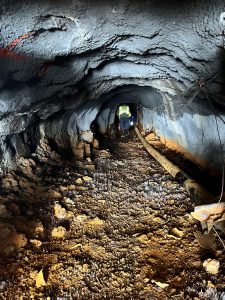
The La Plata Project – I really enjoyed the concentrated field time walking the hydrology of a place with which I’m not very familiar. I also appreciated the conversations it provoked around the ethics of mining and modern-day technology.